

What Actually Makes a Perfume Last Longer?

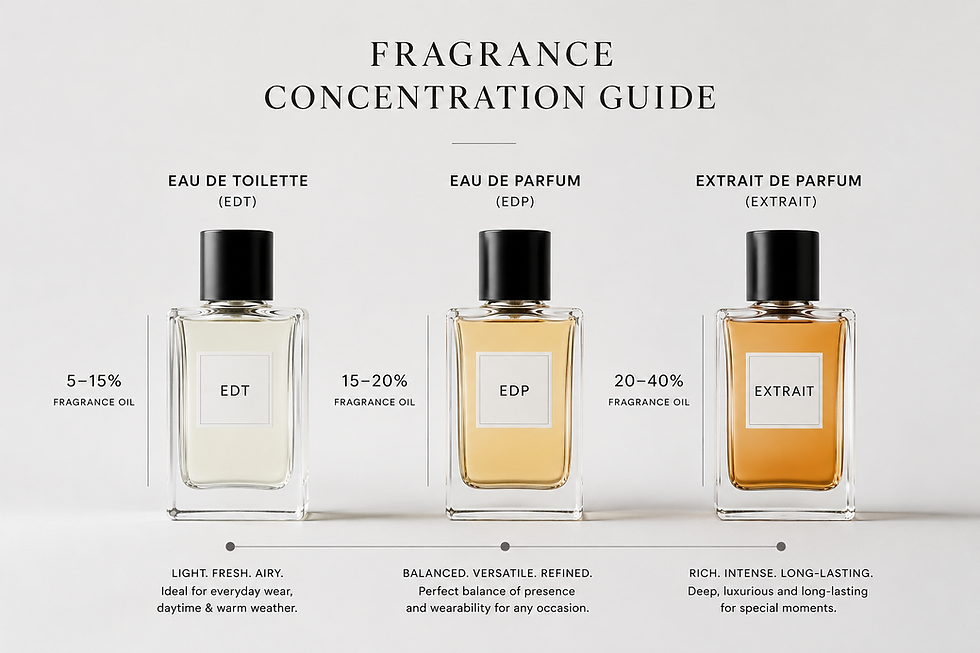
Many people assume that a long-lasting perfume simply means a higher fragrance concentration. However, from my perspective as a perfumer, longevity is influenced far more by the raw materials inside the formula than by concentration alone. The true secret behind lasting power lies in molecular weight, evaporation speed, diffusion, and how different materials interact with one another over time.
Understanding Perfume Longevity
Some Materials Naturally Last Longer
In perfumery, every ingredient evaporates at a different speed. Fresh citrus materials like bergamot, lemon, yuzu, sweet orange, and grapefruit contain highly volatile molecules that evaporate quickly. They create a beautiful, sparkling opening but often disappear within minutes to an hour.
Green and aromatic materials such as lavender, basil, mint, petitgrain, or galbanum generally last slightly longer, but still belong to the lighter side of the fragrance structure. Meanwhile, heavier raw materials form the foundation of long-lasting perfumes. These include:
Woods: sandalwood, cedarwood, patchouli, vetiver
Resins & balsams: benzoin, labdanum, myrrh, tolu balsam
Musks: galaxolide, muscenone, ambrettolide
Sweet materials: vanillin, ethyl vanillin, tonka, coumarin
Animalic & ambery materials: ambergris accords, ambroxan, civet-style notes
These materials evaporate much more slowly because their molecules are heavier and less volatile. They remain on fabric and skin for many hours, sometimes even days.
Fixatives: The Backbone of Longevity
Perfumers also use materials called fixatives to slow down evaporation and help other notes stay longer. Natural fixatives include resins, balsams, patchouli, sandalwood, and labdanum. Modern perfumery also relies heavily on synthetic materials such as Ambroxan, Iso E Super, Cashmeran, Hedione, and musks because they provide both longevity and diffusion.
Interestingly, some materials may not smell extremely strong on their own, but they dramatically improve the performance and radiance of a fragrance formula. For example:
Musks help create a lasting skin scent.
Ambroxan adds radiance and persistence.
Iso E Super creates airy diffusion around the wearer.
Hedione enhances brightness and projection.
These materials act almost like invisible architecture inside a formula.
Balance Matters More Than Strength
A perfume becomes long-lasting not because every material is heavy, but because the formula is balanced properly. If a fragrance contains only dense base notes, it may smell flat or muddy. Perfumers carefully combine volatile top notes, expressive heart notes, and long-lasting base materials to create movement and evolution over time. Longevity is therefore not just about intensity—it is about controlling evaporation rhythm.
Skin and Environment Also Affect Longevity
Even the best formula can behave differently depending on skin chemistry and climate. Dry skin usually causes perfume to evaporate faster, while moisturized skin helps scent molecules stay longer. Heat, humidity, air conditioning, and fabric type can also change how a fragrance performs. This is why the same perfume may last six hours on one person and twelve on another.
The Art Behind Lasting Perfume
From my point of view, creating longevity is a delicate balance between science and artistry. A beautiful long-lasting perfume is not simply loud or overpowering. It unfolds gradually, transitions smoothly, and leaves behind a memorable trace long after the first spray disappears.
Exploring the World of Scent
As we dive deeper into the world of fragrance, it's essential to understand how to create meaningful scents. The journey of crafting a perfume is as intricate as the ingredients themselves. Each note plays a role, and together they form a symphony of aromas that can evoke emotions and memories.
The Role of Personal Experience
Creating a fragrance is a personal experience. Each individual has unique preferences and memories tied to certain scents. This is why I encourage aspiring perfumers to explore their own olfactory experiences. What scents resonate with you? What memories do they evoke? Understanding your personal connection to scent can greatly enhance your ability to create fragrances that resonate with others.
The Science of Scent
The science behind scent is fascinating. It involves understanding how different molecules interact with our olfactory receptors. This interaction is what creates the perception of a fragrance. By studying these interactions, we can better understand how to manipulate ingredients to achieve desired effects.
Crafting Your Signature Scent
When crafting your signature scent, consider the story you want to tell. What emotions do you want to evoke? What memories do you want to trigger? By thoughtfully selecting your ingredients and balancing them, you can create a fragrance that is uniquely yours.
Conclusion: The Journey Continues
The world of perfume is vast and ever-evolving. As I continue to explore this enchanting realm, I invite you to join me. Whether you're an aspiring perfumer or simply a fragrance enthusiast, there is always something new to discover. Together, we can unlock the secrets of scent and create lasting memories through the art of perfumery.
In this journey, I hope to empower you to create meaningful fragrances and help you develop your unique olfactory identity. Remember, the beauty of perfume lies not just in its scent, but in the stories it tells and the emotions it evokes. Let's embark on this aromatic adventure together!

Comments